Every few years the trade press announces the death of email marketing - and this channel consistently proves that reports of its demise are greatly exaggerated. In 2026 the number of email users passed 4.8 billion worldwide, making it the most widely adopted form of digital communication in history. Every day inboxes receive more than 361 billion messages - a rise of 4.3% compared with the previous year, which unequivocally contradicts the narrative about this medium’s decline. While organic reach on social media steadily shrinks, ad costs grow at a rate of 20-30% year over year and AI algorithms change the way users search for information, email remains the only fully controlled channel for reaching an audience.
The shift in the search paradigm - driven by ChatGPT, Google AI Overviews or Perplexity - means that organic traffic to websites is shrinking at an unprecedented pace. TikTok and Instagram are taking over the role of search engines for younger demographics, yet their algorithms remain capricious and unpredictable. In this landscape, the mailing list is becoming a company’s most valuable marketing asset: a direct line to the customer, independent of any external platform. The data confirms this thesis - according to an AdRoll study on marketing trends for 2026, 65% of marketing directors declare an increase in email marketing budgets as a reliable owned channel. It is hard to find a stronger signal of the industry’s trust in this tool.
The strength of email lies in its fundamental advantages: full control over recipient data, the measurability of every element of a campaign and the absence of intermediaries dictating the terms of delivery. No other channel offers such a combination of stability, scalability and cost predictability. While a single social media post reaches on average 2-5% of followers, a well-prepared email campaign lands directly in every subscriber’s inbox. That is a difference impossible to ignore when planning a strategy for the coming quarters.
Table of contents
ROI and key benchmarks - hard data for 2025/2026
A discussion about the value of email marketing should start with hard numbers, and those are unambiguous. The average return on investment in email campaigns ranges from 36 to 45 dollars for every dollar spent, which translates into more than 3500% ROI. No other digital channel - neither paid advertising campaigns nor social media campaigns - comes close to such a result. The reason is simple: email is a direct channel in which you do not pay for the impression itself, you do not fight the algorithm and you do not bid against competitors for the recipient’s attention.
Engagement metrics differ depending on the measurement methodology, yet they hold an impressive level. According to GetResponse data for 2024, the average open rate in the industry reaches 39.6%, although more conservative estimates - taking into account the impact of Apple Mail Privacy Protection on the reliability of opens - place it closer to 23.4%. A click-through rate of 2.6% may seem modest, yet on lists numbering tens or hundreds of thousands of subscribers it generates real, measurable revenue. It is worth stressing that 95% of marketers rate email marketing as effective in achieving business goals - an almost unanimous verdict from practitioners.
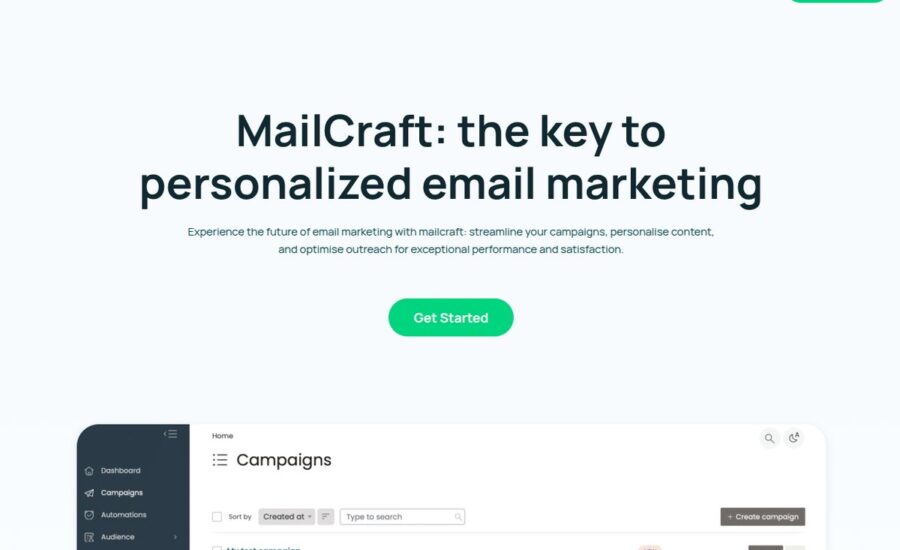
Abandoned cart recovery remains a particularly promising area. The abandonment rate reaches 70% on desktop and as much as 85% on mobile devices - an enormous pool of potential transactions that can be closed with a well-constructed sequence of automated messages. Companies that treat recovery rate as a priority recover as much as 40% of the value of abandoned orders within a single campaign. On the Polish market, solutions such as Mailcraft from Web Systems simplify the management of this type of campaign, helping brands achieve results above industry benchmarks thanks to an intuitive interface and ready-made automation scenarios.
Tip: Do not treat industry averages as a target - treat them as a starting point. Segment your list by purchasing behavior and test A/B variants on 10% of recipients before sending to the remaining 90%. This approach regularly raises CTR by 0.5-1 percentage point, which at large scale translates into a significant increase in revenue.
AI, automation and hyper-personalization - the new standard in 2026
Artificial intelligence has stopped being a technological curiosity in email marketing - it has become an integral operational element of it. In 2026 AI algorithms not only generate message subject lines and support content creation, but above all predict the optimal send time for each individual subscriber. The Send Time Optimization mechanism analyzes a specific recipient’s history of opens and clicks, divides the day into 24 one-hour windows and assigns each of them an engagement score - weighting clicks more heavily than opens alone. The result is delivery precision unattainable with manual campaign planning.
Lifecycle automations form the backbone of a modern email strategy. Welcome series, onboarding, nurturing and winback - these sequences run 24 hours a day, 7 days a week, without human intervention, reacting to specific user behavior in real time. Someone signed up to the list - they receive a welcome series matched to the signup source. Someone abandoned a cart - they get a reminder with a dynamic product recommendation. Someone has not opened a message for 30 days - a reactivation sequence fires. This approach radically outperforms one-off mass campaigns in effectiveness, because every message appears in the context of a real action by the recipient.
Hyper-personalization in 2026 goes far beyond a first name in the header. Dynamic content blocks adjust the message contents to browsing history, product preferences and the stage in the customer lifecycle. Behavioral segmentation makes it possible to create micro-segments that respond to subtle intent signals - three visits to the pricing page, downloading a case study or adding a product to a wish list. The foundation of this personalization is becoming zero-party data: information customers share voluntarily in exchange for more relevant content. Asking directly about preferences - through newsletter surveys, preference centers or automated welcome emails - is replacing the expiring third-party cookies as a source of knowledge about recipients.
“We could not believe how quickly we managed to roll out the abandoned cart recovery path - and the returns turned out to be phenomenal. Automation based on user behavior helped us re-engage buyers at the right moment with the right content.”
- E-commerce Director at Slazenger, after achieving 49x ROI and 700% growth in customer acquisition
Tip: When implementing AI in email campaigns, do not hand the algorithms full control over communication. Use artificial intelligence as a partner for generating variants and optimizing send parameters, but run every message through the filter of human sensitivity - subscribers quickly recognize an impersonal, machine-generated tone and lose engagement.
Smart inboxes and new KPIs - how to measure success in 2026
The deliverability landscape has changed fundamentally compared with what we knew just a few years ago. Smart Inbox in Gmail and Outlook uses artificial intelligence to prioritize correspondence, automatically categorizing messages as “primary”, “promotions” or “social”. This means that simply reaching the inbox no longer guarantees being noticed - what counts is the ability to break through an intelligent filter that evaluates a given user’s history of interaction with the sender. Mail providers analyze individual behavior patterns ever more intensively: reading time, click frequency and the regularity of opening messages from a specific sender decide whether the next campaign lands in the primary tab or is pushed to the margin.
Apple Mail Privacy Protection, introduced in 2021, definitively undermined the reliability of open rate as a standalone measure of success. This feature automatically downloads tracking pixels regardless of whether the user actually opened the message, artificially inflating the statistics. In 2026 marketers have to rebuild their analytics dashboard around metrics that reflect real engagement:
- Click-through rate (CTR) - how many recipients actually go through to the linked pages
- Engagement over time - how the activity of individual subscribers changes over the following weeks and months
- Deliverability score - the deliverability indicator, bounces, subscriptions and opt-outs as a measure of list quality
- Satisfaction rate - whether recipients value the content they receive (measured for example with NPS surveys in the newsletter)
- Final conversions - the only metric that really interests the board: revenue generated by the email channel
The technical foundations of deliverability have acquired the status of an absolute minimum. In 2026 Google and Yahoo block senders without full authentication covering three protocols: SPF (a list of authorized IP addresses), DKIM (a cryptographic signature confirming the integrity of the message) and DMARC (a policy defining how to handle messages that fail verification). The absence of any of these elements results in the message being rejected before it even reaches the inbox - regardless of content quality or brand reputation. On top of that comes the need to warm up new domains: starting from 20-50 trusted messages a day with a gradual increase in volume over a minimum of four weeks.
The visual aspect also requires adaptation. Most mobile users use a dark interface theme, which means that optimization for dark mode has stopped being an option - it has become a necessity. A transparent PNG logo disappearing on a dark background, unreadable color contrasts or bright graphic elements that hurt the eyes are problems that directly lower engagement metrics.
Tip: Configure SPF, DKIM and DMARC for every sending domain, and before launching a campaign check the message preview in both light and dark mode. This two-minute verification can save the deliverability score of an entire campaign.
Retention and authenticity - a competitive advantage that is hard to copy
The cost of acquiring a new customer has been rising continuously for several years, and in 2026 this trend shows no signs of slowing. Companies with developed retention email marketing achieve 90% higher retention and 250% higher lifetime value compared with organizations relying exclusively on single-channel acquisition strategies. This is a fundamental economic asymmetry: keeping an existing customer costs many times less than winning a new one, and a well-designed email sequence can turn a one-time buyer into a loyal brand ambassador. Fashion brands such as NA-KD confirm this pattern - unifying customer data and hyper-personalizing communication brought them a 25% increase in CLTV in just 12 months.
In the era of generative artificial intelligence, when algorithms can produce endless amounts of smooth, correct text, authenticity is becoming a currency of growing value. Subscribers are not looking for perfectly polished newsletters - they want real stories, the people behind the brand and honest answers to their questions. Showing the sender’s face, sharing what goes on behind the scenes of the team’s work and even admitting failures builds a bond the competition cannot copy. Encouraging recipients to reply to messages and actually reading those replies transforms a newsletter from a monologue into a dialogue - and dialogue builds loyalty more effectively than the best promotional offer.
Regularity of publication remains one of the most underrated success factors. A newsletter sent consistently for years - at a steady rhythm, with predictable quality - outperforms the best one-off campaign, because it builds a habit of expectation in the inbox. Subscribers start treating regular messages as a fixed element of their week, and that predictability translates into trust impossible to build with sporadic sends.
The foundation of long-term effectiveness is mailing list hygiene. A sunset policy - the systematic management of inactive addresses - protects the reputation of the sending domain and prevents the degradation of engagement metrics:
- 30 days of inactivity - moving to an “at risk” segment with dedicated reactivation communication
- 60 days of inactivity - launching a re-engagement campaign with a clear question about the wish to keep receiving messages
- 90 days of inactivity - suspending sends to the given address
- 6 months of inactivity - removal from the list in order to protect deliverability
Continuing to send to “ghosts” lowers the aggregate open rate, signaling to mail providers - especially Gmail - that the sender is irrelevant. The consequence is that future messages get pushed to spam for all recipients, including the most engaged ones. Weekly removal of hard bounces and ongoing monitoring of the complaint rate are the indispensable operational minimum.
A strategic foundation, not a backup tactic
Email marketing in 2026 is not a contingency plan launched when other channels fail - it is the foundation of a marketing strategy in an era of shrinking organic reach, rising ad costs and the progressive fragmentation of consumer attention. Companies that invest consistently in this channel accumulate priceless first-party and zero-party data, build direct relationships with recipients and protect themselves against the whims of external platforms. It is a competency advantage that grows with every month of systematic work.
The key pillars of success in email marketing for 2026 form a coherent ecosystem: owned data (collected directly from customers through surveys, preference centers and interactions with content), lifecycle automation (welcome series, nurturing, winback running non-stop), hyper-personalization (dynamic content matched to an individual’s behavior and preferences), technical deliverability (full SPF/DKIM/DMARC authentication, list hygiene, domain warm-up) and authentic communication (real stories, a human voice, regularity that builds a habit). None of these elements works in isolation - only their synergy generates results many times above industry benchmarks.
The coming months will bring further evolution of smart inboxes, tighter deliverability requirements and a growing role for AI in optimizing every campaign parameter. Brands that already treat email marketing as a strategic priority today - rather than an operating cost - will hold a competitive advantage that latecomers will find hard to make up. Investment in proven marketing solutions, team competencies and data quality pays back within a horizon of 6-12 months, creating a self-reinforcing cycle of better results and deeper customer relationships.
The control question worth asking yourself right now is this: would your subscribers notice if your newsletter was missing? Would they feel an emptiness in their inbox if the next message did not arrive at its usual time? If the answer is no - you know exactly what to work on in 2026. Building a newsletter that people miss is the most effective marketing strategy you can implement today.