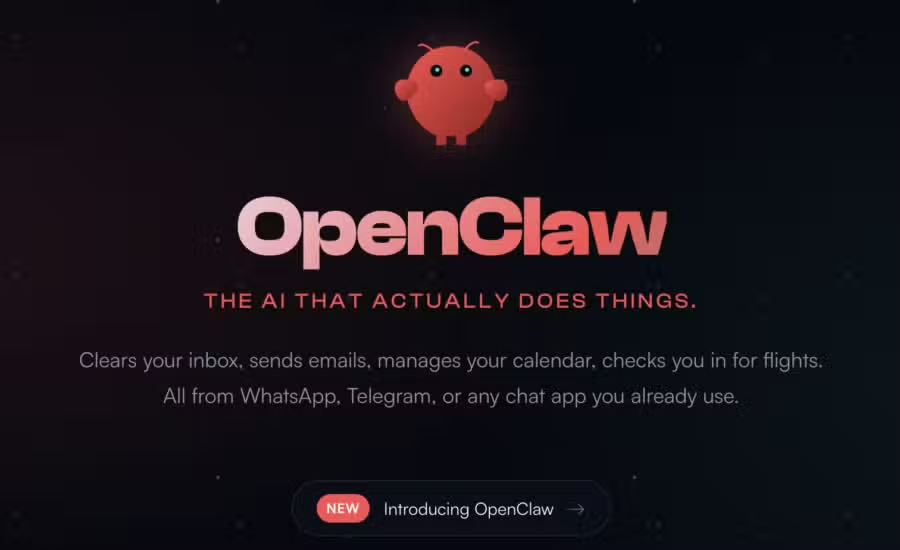
For a long time the world of AI tools revolved around a single pattern: the user asks a question, the model answers. ChatGPT, Claude, Gemini - they all work reactively. It is only openclaw.ai (previously known as cloudbot / moltbot) that introduces a real paradigm shift. We are no longer talking about an assistant, but about an autonomous agent that keeps working even while you sleep.
This is not yet another wrapper around a language model, nor a simple interface for chatting with AI. It is a complete environment you can run on your own server, with full control over data, access and the way the system behaves. The architecture allows for gradual expansion - both with integrations into existing systems and with your own business logic.
The platform lets you equip agents with long-term memory, define recurring tasks and set up mechanisms that react to events. In practice this means the system does not merely answer queries - it can carry out specific operations on its own: analyze data, initiate processes, call APIs or make decisions within defined rules.
For teams developing e-commerce, web applications and process automation systems this is a genuine leap in quality - a move away from manually driven integrations and one-off prompts toward permanent, autonomous components that support entire products and business processes.
Table of contents
An agent, not a chatbot - the key difference
A classic AI assistant requires the user to take the initiative. Without a prompt, nothing happens. Openclaw.ai works differently - it has a heartbeat mechanism, a recurring “pulse” that checks at set intervals whether there are any tasks waiting to be done.
In practice this means the agent can:
- run overnight research (for example market analysis or industry news),
- synchronize data from project tools,
- update documentation,
- prepare daily or weekly summaries,
- react proactively, without being triggered manually.
This is exactly the element missing from the typical AI tools used today in online marketing or e-commerce development.
Installation on your own infrastructure - freedom and responsibility
One of the most important aspects of openclaw.ai is that it is not a SaaS. The agent runs on your own VPS, a local machine or a dedicated mini-computer. That is a huge advantage from the point of view of technology companies, but also a source of risk.
The agent has real access to the operating system:
- it creates and modifies files,
- it starts processes,
- it uses CLI tools,
- it integrates with external APIs.
That is why you should not install it on your main working computer. At Web Systems we advise against that approach - an isolated environment is far safer: a VPS, a container or a separate machine dedicated to the bot alone.
Open source and rapid development - an advantage and a threat
Openclaw.ai is an open source project, developed by the community at an extremely fast pace. That is good news - it means transparency and room to grow. At the same time it has to be said plainly: security is not keeping up with the hype.
The very high number of issues, pull requests on Github and changes in the repository shows that the project is young. From a business perspective this means one thing: you should not yet connect critical financial data, ERP systems or the company’s full mailbox to the agent.
This is a tool for experimenting and building an edge, but with a healthy dose of distance.
Skills and integrations - how does the agent learn?
Openclaw.ai is built around so-called skills, modules that extend its capabilities. You can:
- install them from repositories,
- build them yourself,
- integrate them with external tools (CRM, project management, code repositories).
Thanks to this, the agent can act as:
- an automated e-commerce analyst,
- an overnight code reviewer,
- an aggregator of project knowledge,
- support for the marketing team.
This approach is particularly interesting for companies building custom web applications and e-commerce platforms, where automating internal processes has a real impact on the margin.
Second brain and private OS - a new model of working with knowledge
One of the most groundbreaking uses of openclaw.ai is the concept of a second brain - a system that:
- remembers project context,
- analyzes meetings,
- connects data from different systems,
- draws conclusions over time.
The agent does not just store information, it learns from its mistakes, updates its own instructions and optimizes the way it operates. That is a completely different level from static prompts or predefined workflows.
For technology companies this means a real opportunity to build a private operating system for knowledge, tailored to their own processes.
Language models and costs - how to approach this sensibly?
Openclaw.ai is not a model in itself - it uses external LLMs (Claude, Gemini or OpenAI, for example). The key rule is simple:
the agent’s main “brain” should use the best model available, while cheaper models can be used in subagents.
With intensive use the costs can grow quickly. That is why a sensible configuration looks like this:
- a premium model as the core,
- cheaper fallbacks,
- avoiding direct API use wherever a subscription is possible.
This is exactly the kind of architectural decision where the experience of a software house genuinely matters.
Is this a solution for everyone?
No. Openclaw.ai is not a tool for non-technical users. It requires:
- an understanding of infrastructure,
- awareness of the risks,
- the ability to isolate environments,
- discipline in managing access rights.
For companies like Web Systems - building e-commerce, applications and automations - it is nevertheless a very promising direction. Not as a finished product, but as a platform for building your own AI agents, precisely matched to your business needs.
Summary - hype or real change?
Openclaw.ai is not a passing curiosity. It is a signal that AI is moving from the level of a tool to the level of an autonomous system. Still imperfect, still risky, but already showing what the future of working with technology may look like.
The key question today is not: Is this worth looking into? The real challenge is: How do we do it wisely, safely and with real business value?
If this topic matters to you and you want to approach it professionally, get in touch with us. We are already working with Openclaw and we know how to use this tool in practice so that it helps with everyday work.